Mischief Makers: The Evolution of Mushroom Illustrations Exhibit
August 4 - November 1, 2026
Located in the Archives and Special Collections, The Dodd Center for Human Rights, UConn Storrs
Mischief Makers: the Evolution of Mushroom Illustrations is a collaborative exhibit designed by the CSMNH and the UConn Libraries Archives and Special Collections. It offers selections from the Ethel R. Warkov Collection of mushroom paintings alongside comparative illustrations from historical mycology texts from the Archives and Special Collections. The exhibit features a rotating selection of paintings and illustrations. It is on view now at the Dodd Center for Human Rights at UConn through October 30.
Hours: 9am to 12pm, 1pm-4pm, Tuesday through Friday
Free and open to the public!
The Legacy of a Lifetime of Collecting
The Carl and Marian Rettenmeyer Story
Located in the Gant Science Complex Light Court, UConn Storrs
Hours: 7am to 7pm, Monday through Friday
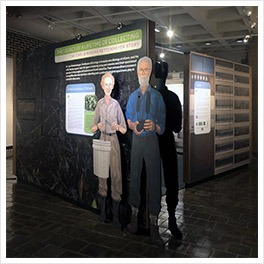
Dr. Carl Rettenmeyer and his wife Marian spent over 50 years studying army ant colonies and their associated species in the jungles of Central America. Using four interactive digital media stations, large format graphics, and an immersive soundscape to communicate the story of their extraordinary research, this exhibit explores the vital role that collecting and curating biological specimens play in scientific discovery.
Previously located in the ground floor lobby of the Homer Babbidge Library, UConn Storrs
Right Below Your Feet
A Beautiful Evolutionary Success Story
Located in the Wilbur Cross Building Atrium
Hours: 8:30am to 4:30pm, Monday through Friday
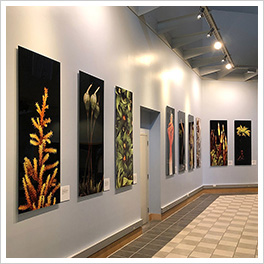
This exhibit introduces a group of plants called Bryophytes, composed of about 20,000 species that reproduce via spores rather than seeds. Here we offer a closer look at some of the factors that have contributed to the remarkable evolutionary success of Bryophytes. We also hope you will appreciate their astonishing intrinsic beauty.
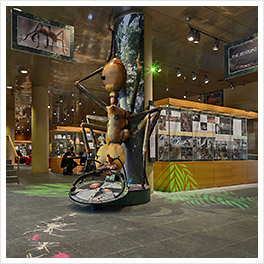
Be Our Guest
The Complex Society of Army Ants and Their Guests
Located in the lobby of the Biology/Physics Building, UConn Storrs
Hours: 7am to 7pm, Monday through Friday
Come visit our giant 12' army ant and see if you can find all the guests located on it. Learn about the biology of Eciton burchellii, and how hundreds of species of guests interact with army ant colonies to create a fascinating and complex biological system.
Birds Up Close: Connecticut State Museum of Natural History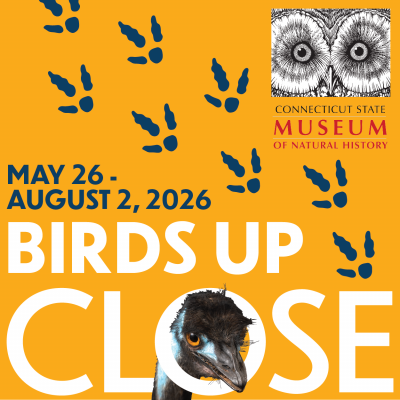
May 26 - August 2, 2026
Located in the William Benton Museum of Art,
245 Glenbrook Rd, UConn Storrs
Hours: 10am to 4pm, Tuesday through Friday; 1pm to 4pm Saturday & Sunday
The Connecticut State Museum of Natural History (CSMNH) has partnered with the William Benton Museum of Art to bring visitors face-to-face with a remarkable avian collection at UConn. Featuring more than 30 preserved specimens, the Birds Up Close exhibition offers an intimate look at bird diversity, showcasing examples of birds of prey, perching birds, ducks and other waterfowl, a striking emu specimen, and an example of the Museum’s trademark owl. Birds Up Close explores the history of early collecting practices, and the role natural history collections have played in shaping scientific knowledge. Visitors are invited to consider how these specimens were gathered, studied, and preserved, and how museum practices have evolved over time. Contemplating natural history specimens as works of art, the exhibition highlights the enduring value of avian collections to research, education, and public understanding today. In this exhibit, you will get a rare, up-close view of birds from around the world, held by the CSMNH as part of the F. Eugene Allen collection. Most of the animals were carefully preserved by taxidermists over 100 years ago! These stunning natural history specimens have been prepared in a way that allows you to see details in bird form and function, which can be overlooked unless you can see birds up close.
Bird species outnumber all other groups of vertebrates, or animals with back bones. There are around 11,000 species of birds alive today and new species are being discovered by scientists all the time. Birds are both the most diverse group of land animals and the only animals alive today that have feathers. Feathers help birds fly, swim, stay warm and dry, camouflage themselves to avoid predators, and even attract mates with bright, stunning colors!
Along with possessing different types of feathers, birds have body sizes and shapes that reflect their behaviors and the habitats in which they live. Adaptations, which arise from evolution by natural selection, help animals survive and reproduce in their environments. Over time, distinct types of birds have developed adaptations such as different ways of feeding, flying, swimming, making nests, singing, and finding mates. Imagine the long, slender beak of a hummingbird that drinks nectar from tube-shaped flowers. Now think of the stubby, sharp beak of an owl that eats small mammals. These dissimilar beak shapes allow birds to specialize and eat the different types of food found in different habitats.
This exhibition is supported in part by Liberty Mutual Insurance. "LiMu Emu is proud to support their high-flying friends!"
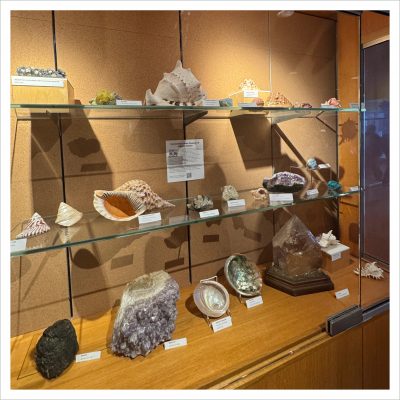
Uniquely UConn
Uncovering the remarkable collections across campus
Located in the Gallery on the Plaza, Homer Babbidge Library, UConn Storrs
On display through May 15, 2026
Homer Babbidge Hours of Operation
Mollusks, fine art, winning game balls, and puppets all have something in common – UConn! UConn is home to many collections curated for scholarly, educational, and preservation purposes. Each collection presents an opportunity to experience new things, take a trip down memory lane, enjoy the talents of artists at home and across the world, and enhance your research.
Exhibitors on display include Ballard Institute & Museum of Puppetry, Botanical Conservatory, Connecticut State Museum of Natural History, J. Robert Donnelly Husky Heritage Sports Museum, School of Pharmacy, UConn Library Archives & Special Collections, and the William Benton Museum of Art.
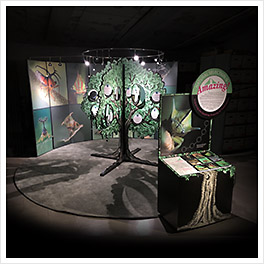
Natural Selection is Amazing!
Exploring the Dazzling Diversity of Treehoppers
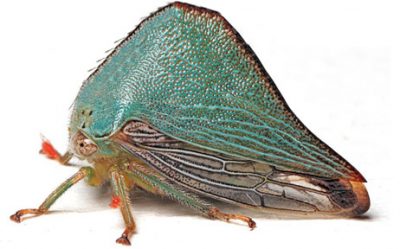
One group of animals expresses the power of natural selection in a particularly vivid way. This group shares a unique physical structure, not seen in other animals, that manifests itself in a dizzying array of fascinating and beautiful forms. This exhibit explores how the amazing power of natural selection has shaped the natural history of one lineage of insects—the treehoppers.
Previously located in the Gant Science Complex Light Court, February - January 2024
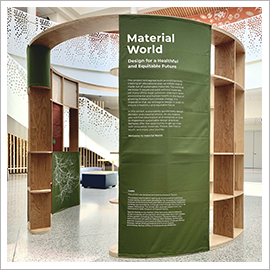
Material World
Design for a Healthful and Equitable Future
The design industry is responsible for excessive amounts of waste... But what if there was an alternative?
A true sum of its parts, "Material World: Design for a Healthful and Equitable Future" is an evolving proof-of-concept and educational resource for sustainable exhibition design. Cameron Slocum's research, planning, and construction of Material World demonstrate real-life examples of attainable alternatives. The project personifies the designer's re-imagination of material culture in the design sphere.
“Material World” is the project of Cameron Slocum, an undergraduate industrial and digital media and design student in the School of Fine Arts at UConn Storrs.
Previously located in the Gant Science Complex Light Court, August - December 2023
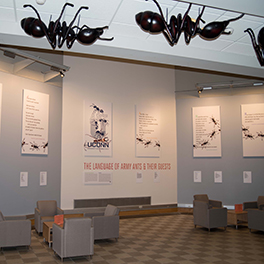
The Literature of Army Ants & Their Guests
This AntU installation showcases student poetry inspired by the biology of army ants and their guests. Included are works from Bruce Cohen’s creative writing classes (ENGL 3003W, ENGL 3701) and from the Educational Center for the Arts in New Haven, as well as in Darcie Dennigan’s Nature Writing Workshop (ENGL 3715). Visitors were invited to, if they were so inspired, create their own poem on the 50-foot interactive poetry board.
Previously located in the Lobby Rotunda of the Wilbur Cross Building, UConn Storrs